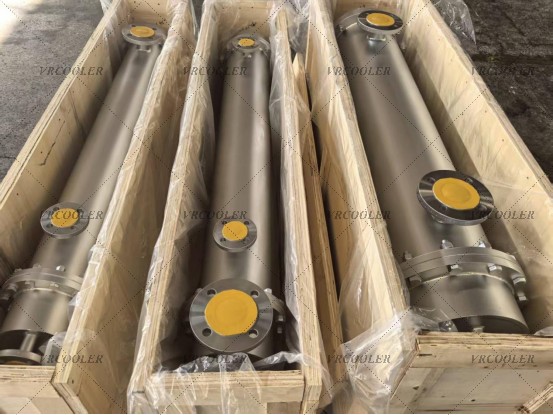
Material selection depends mainly on whether the component contacts raw seawater or treated freshwater. In a typical auxiliary-engine jacket-water cooler, seawater flows through the tubes and closed-loop jacket water flows through the shell.
Cu-Ni 90/10 is a common choice for general marine seawater service because it offers good resistance to corrosion, erosion, and biofouling. Cu-Ni 70/30 may be selected where higher seawater velocity or greater erosion resistance is expected.
Titanium Grade 2 provides excellent resistance to seawater, chloride attack, and marine corrosion, making it suitable for demanding vessels, high-salinity water, or long-service applications. Duplex 2205 and super duplex 2507 are also suitable where high strength and chloride-corrosion resistance are required.
316L stainless steel is generally more suitable for the treated freshwater jacket-water side. It should be selected cautiously for continuous raw seawater service because chloride-induced pitting and crevice corrosion may occur.
For most auxiliary-engine jacket-water coolers, a Cu-Ni tube bundle with a coated carbon-steel shell is a practical and economical configuration. The final material selection should also consider seawater temperature, flow velocity, pressure, galvanic compatibility, classification requirements, and the engine manufacturer’s specifications.