
Material selection must consider seawater temperature, chloride concentration, flow velocity, suspended solids, oil pressure and the required service life. The seawater-wetted components require the greatest corrosion resistance, while the oil-side shell can normally use less expensive materials.
For the heat-transfer tubes, 90/10 copper-nickel is commonly used in marine gearbox-oil coolers because it offers good seawater corrosion resistance, thermal conductivity and resistance to biofouling. 70/30 copper-nickel provides greater resistance to high-velocity seawater, erosion and demanding offshore conditions. Aluminium brass is another traditional option for clean, controlled seawater service.
Titanium Grade 2 is preferred when maximum resistance to chloride pitting, crevice corrosion and polluted seawater is required. It provides a long service life and permits relatively high seawater velocity, although its initial cost is higher. Duplex 2205 and Super Duplex 2507 may also be considered, but their suitability depends on temperature, chloride level, fabrication quality and crevice conditions.
Standard 304 or 316L stainless-steel tubes are generally not the first choice for warm, stagnant or untreated seawater because they can suffer chloride pitting and crevice corrosion. Their use should be supported by a detailed corrosion assessment.
Tube sheets can be manufactured from naval brass, copper-nickel alloy, titanium, Duplex stainless steel or carbon steel with a corrosion-resistant cladding. Tube and tube-sheet materials should be selected as a compatible combination to reduce galvanic corrosion.
Water boxes are often made from cast iron or fabricated carbon steel with a rubber, neoprene or marine-grade epoxy lining. Bronze or copper-nickel water boxes can be used for more demanding service. Replaceable zinc or aluminium anodes are commonly fitted to protect the seawater chambers, although the cathodic-protection system must be compatible with the selected tube material.
The oil-side shell is typically carbon steel, while stainless steel may be selected for special oils, contamination-sensitive systems or corrosive environments. NBR seals are commonly suitable for mineral gearbox oils, while FKM can be used for higher temperatures or synthetic lubricants. Seawater-only seals may use EPDM, but EPDM should not contact mineral oil.
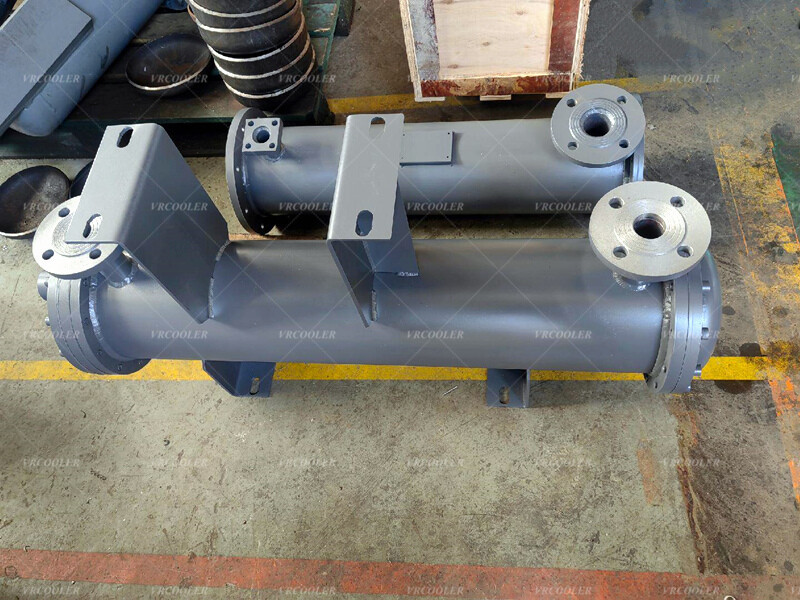
For most marine gearbox-oil coolers, a practical construction is a carbon-steel shell, 90/10 copper-nickel tubes, compatible copper-alloy tube sheets and neoprene-lined steel water boxes with replaceable anodes. Titanium tubes and titanium-clad tube sheets are recommended when long service life and maximum seawater resistance are priorities.
