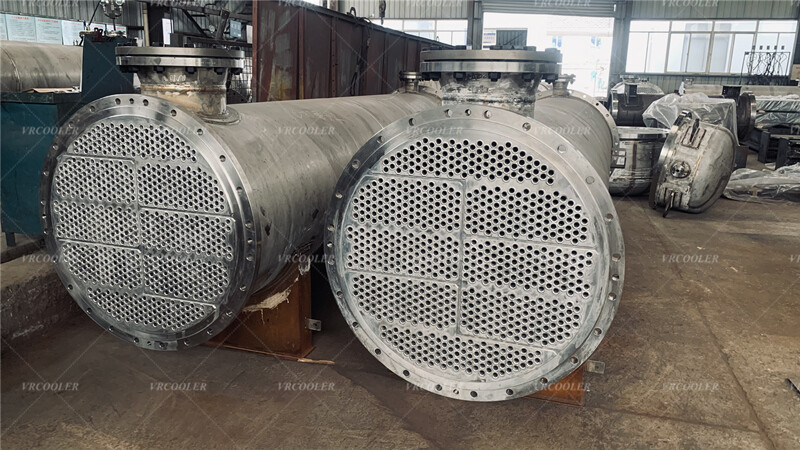
Duplex or super duplex stainless steel is selected when conventional 304L or 316L stainless steel cannot provide sufficient resistance to pitting, crevice corrosion, erosion-corrosion or chloride stress-corrosion cracking. It is particularly valuable in power-plant shell-and-tube heat exchangers exposed to seawater, brackish water, concentrated cooling-tower water or chemically contaminated process fluids.
When duplex 2205 is suitable
Duplex 2205, commonly specified as UNS S32205 or S31803, is often appropriate for moderately aggressive chloride environments. Typical applications include treated cooling water, some brackish-water systems, closed-loop coolers and tube sheets or water boxes requiring better corrosion resistance and higher strength than 316L.
When super duplex 2507 is required
Super duplex 2507, normally UNS S32750, is considered for more severe conditions, including:
- Warm seawater or high-chloride cooling water
- High operating temperatures combined with chlorides
- Stagnant areas and deposit-forming water
- Tube-sheet crevices and gasketed connections
- High fluid velocities that create erosion-corrosion risks
- High-pressure equipment where greater mechanical strength is beneficial
- Offshore, coastal, desalination and concentrated-brine applications
- Systems where leakage, shutdown or tube replacement would have serious consequences
In seawater-cooled condensers and auxiliary coolers, super duplex may be specified for tubes, tube sheets, water boxes, nozzles or all wetted components. A more economical design may use super duplex tubes with clad tube sheets and coated carbon-steel water boxes.
Selection cannot be based on chloride concentration alone
The correct grade depends on the combined effects of chloride level, maximum temperature, pH, oxygen content, flow velocity, deposits, biological activity, shutdown conditions and cleaning chemicals. Crevices under gaskets or deposits can create much more aggressive local conditions than the general water analysis suggests.
Duplex materials also require controlled welding, appropriate filler metals, proper heat input, ferrite verification, pickling and passivation. They are not automatically the best choice for every application: titanium, copper-nickel alloys or higher nickel alloys may be more suitable for certain seawater, acidic or high-temperature duties.
A complete water analysis and operating profile should therefore be reviewed before selecting 2205, 2507 or another corrosion-resistant alloy.