
For small packaged heat pumps, a compact brazed plate heat exchanger can be a very good choice. It is efficient, small, and cost-effective when the water circuit is clean and the operating conditions are stable. But for industrial heat pumps, especially high-capacity systems used in factories, district heating, waste heat recovery, process heating, chemical plants, food processing, and energy recovery projects, a shell and tube heat exchanger is often the safer and more reliable long-term solution.
The reason is simple: industrial heat pumps do not always work with clean water and ideal conditions. They often handle glycol, brine, wastewater, process water, cooling tower water, oil-contaminated water, seawater, or high-temperature process fluids. In these applications, durability, cleanability, pressure resistance, and service life become more important than compact size alone.
1. Better for Dirty or Fouling Fluids
A brazed plate heat exchanger has narrow flow channels. This gives high heat transfer efficiency, but it also makes the exchanger more sensitive to fouling, particles, scale, sludge, fibers, oil, and biological growth.
In industrial heat pump systems, the heat source may come from:
- Wastewater
- Process cooling water
- Cooling tower water
- River water or seawater
- Brine or glycol loops
- Industrial exhaust heat recovery circuits
- Oil-contaminated process water
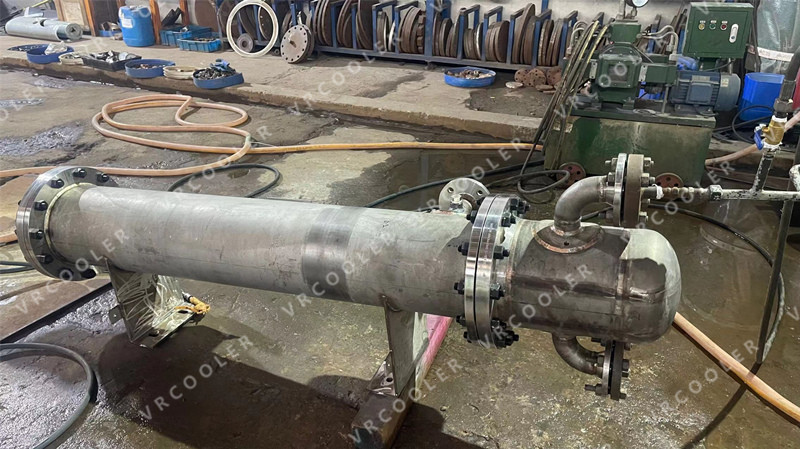
For these fluids, shell and tube exchangers are easier to design with larger flow passages, suitable tube diameter, removable covers, and mechanical cleaning access. If fouling occurs, the tubes can be cleaned, inspected, plugged, repaired, or replaced. A brazed plate exchanger usually cannot be mechanically cleaned internally, and once blocked or severely fouled, replacement is often the only practical solution.
2. Easier Maintenance and Longer Service Life
In industrial plants, downtime is expensive. Maintenance teams prefer equipment that can be opened, inspected, cleaned, and repaired.
A shell and tube heat exchanger can be designed with removable heads, removable tube bundles, replaceable tubes, drain connections, vent connections, and inspection ports. This makes it suitable for long-term industrial operation.
A brazed plate exchanger is sealed by brazing, usually copper or nickel. It has no gasketed opening structure. This is compact and strong, but it also means internal inspection and mechanical cleaning are limited. For clean closed-loop systems, that may be acceptable. For heavy industrial service, it can be a risk.
3. More Flexible Material Selection
Industrial heat pumps may use different refrigerants and fluids, such as ammonia, CO₂, R134a, R1234ze, R513A, glycol, brine, thermal water, seawater, or process liquids. Some systems also involve high chloride content or corrosive media.
Shell and tube exchangers offer more flexibility in material selection. The shell, tubes, tube sheets, baffles, and covers can be made from different materials according to the working condition.
Common options include carbon steel, stainless steel 304/316L, duplex stainless steel, titanium, CuNi, and special alloys.
This is very useful when one side is refrigerant and the other side is corrosive water or industrial process fluid. In contrast, brazed plate exchangers are limited by plate material and brazing material compatibility. Copper-brazed plates are not suitable for ammonia, and some fluids may attack copper or nickel brazing.
4. Better for Large Capacity Industrial Systems
As heat pump capacity increases, the heat exchanger must handle larger refrigerant flow, larger water flow, higher pressure drop control, and more stable distribution.
Shell and tube exchangers are well suited for medium and large industrial heat pumps because the design can be customized for high flow rate, low pressure drop, multi-pass arrangement, flooded evaporation, dry expansion operation, condensation, desuperheating, or subcooling.
For large systems, a shell and tube exchanger may take more space, but it gives better mechanical robustness and easier service. In many industrial projects, reliability is more important than saving a small amount of installation space.
5. Stronger Against Thermal Stress and Operating Fluctuation
Industrial heat pumps often experience load changes, start-stop cycles, variable flow, high temperature lift, and fluctuating heat source temperature. These changes can create thermal stress inside the heat exchanger.
Shell and tube exchangers can be designed with U-tube, floating head, expansion joint, or special tube sheet structures to handle thermal expansion. This is valuable in high-temperature heat pump systems and waste heat recovery applications where temperature differences can be large.
Compact brazed plate exchangers have many brazed contact points. They are strong under normal conditions, but repeated thermal cycling, freezing risk, water hammer, or pressure pulsation can shorten service life if the system is not well controlled.
6. Lower Risk in Critical Industrial Operation
For a residential or commercial heat pump, exchanger replacement may be manageable. For an industrial heat pump connected to production, boiler replacement, waste heat recovery, district heating, or process heating, unexpected failure can stop the plant.
A shell and tube exchanger gives operators more options during maintenance. If several tubes are leaking, they can often be plugged temporarily. If the bundle is damaged, it can be repaired or replaced. This reduces total lifecycle risk.
With a brazed plate exchanger, internal leakage or serious blockage usually means replacing the whole unit.
Shell and Tube vs. Brazed Plate for Industrial Heat Pumps
When Is a Brazed Plate Exchanger Still a Good Choice?
A brazed plate heat exchanger is still a good option when the system is clean, compact, and well controlled. For example, it can work well in small packaged heat pumps, clean closed-loop water systems, domestic hot water heat pumps, and limited-space equipment.
The key point is not that shell and tube is always better. The key point is that industrial heat pump conditions are often more severe, and shell and tube exchangers provide better tolerance for fouling, pressure drop, corrosion, thermal stress, and maintenance.
Conclusion
For industrial heat pumps, a shell and tube heat exchanger is often chosen over a compact brazed plate exchanger because it is stronger, easier to clean, easier to repair, more flexible in material selection, and better suited for dirty or high-capacity systems.
A brazed plate exchanger offers excellent compactness and efficiency, but it requires clean fluids and stable operating conditions. In industrial projects where reliability, service life, and maintenance access are critical, shell and tube design is usually the more practical long-term choice.
Vrcoolertech can customize shell and tube evaporators, condensers, desuperheaters, and process heat exchangers for industrial heat pump systems according to refrigerant type, heat source fluid, heating medium, pressure level, temperature range, corrosion risk, and installation space.
