
Hydroprocessing units, including hydrotreaters and hydrocrackers, are some of the most demanding services in a refinery. The process involves high temperature, high pressure, hydrogen-rich gas, sulfur compounds, nitrogen compounds, and heavy hydrocarbon streams. In this kind of environment, the heat exchanger is not only a heat transfer device. It is a pressure-retaining, corrosion-resistant, safety-critical piece of refinery equipment.
That is why shell and tube heat exchangers are still widely used in hydroprocessing units.
Built for High Pressure and Hydrogen Service
Hydrotreaters and hydrocrackers often operate under high pressure. The exchanger must safely contain hydrogen-rich process streams and heavy hydrocarbons under severe conditions. Shell and tube construction is well suited for this because the pressure boundary is strong, proven, and can be designed according to refinery standards such as ASME, TEMA, and project specifications.
For high-pressure hydrogen service, material selection becomes very important. Depending on the temperature, pressure, hydrogen partial pressure, and process composition, materials may include carbon steel, stainless steel, Cr-Mo alloy steel, clad plate, or other special alloys. Shell and tube design allows different materials to be selected for the shell, tubes, tube sheet, and channels according to the actual corrosion and pressure requirements.
Suitable for Hot Reactor Feed and Effluent Service
One of the most important heat exchanger duties in hydroprocessing is feed-effluent heat recovery. Cold feed is heated by hot reactor effluent before entering the furnace or reactor section. This reduces furnace duty and improves unit efficiency.
In this position, the exchanger may face high temperature, high pressure, and large temperature differences between the hot and cold streams. Shell and tube heat exchangers can be designed with U-tube, floating head, or special expansion structures to handle thermal expansion and reduce mechanical stress.
For a refinery, this reliability is very important because feed-effluent exchangers directly affect energy consumption, reactor inlet temperature control, and unit stability.
Better Resistance to Fouling and Dirty Hydrocarbon Streams
Hydroprocessing streams may contain heavy hydrocarbons, sulfur compounds, particulates, salts, coke precursors, and other fouling materials. In some systems, ammonium salts or corrosion products can also create deposits.
Shell and tube heat exchangers are easier to inspect and clean compared with many compact heat exchanger types. Tube bundles can be mechanically cleaned, chemically cleaned, or replaced when necessary. For dirty services, the exchanger can be designed with suitable tube diameter, tube layout, velocity, baffle spacing, and removable bundle structure to reduce fouling problems and simplify maintenance.
This is one major reason refineries continue to choose shell and tube designs for severe process services.
Handles Corrosion and Sour Service Conditions
Hydrotreaters and hydrocrackers often deal with sour fluids containing hydrogen sulfide, ammonia, chlorides, and other corrosive components. In some parts of the unit, special attention is needed for ammonium bisulfide corrosion, wet H₂S corrosion, chloride stress corrosion cracking, and high-temperature hydrogen attack.
A shell and tube exchanger gives engineers more flexibility to select suitable metallurgy for each side of the exchanger. For example, the tube side may require a higher alloy material, while the shell side may use carbon steel or clad construction depending on the process conditions. This flexible material combination helps balance safety, corrosion resistance, and project cost.
Reliable for Two-Phase and Condensing Duties
Hydroprocessing units include many heat exchanger services, not only liquid-to-liquid heating. Shell and tube exchangers can also be used for vapor cooling, partial condensation, reboiling, product cooling, sour water service, and recycle gas cooling.
They are especially useful when the process involves two-phase flow or phase change. The shell side can be designed to provide enough disengagement space, proper flow distribution, and stable heat transfer performance. This is difficult for some compact exchanger designs, especially under dirty or high-pressure refinery conditions.
Easier Maintenance During Turnaround
In refinery operation, maintenance planning is a serious issue. Equipment must be inspectable, cleanable, and repairable during shutdowns. Shell and tube exchangers are familiar to refinery maintenance teams. Tube plugging, bundle pulling, hydrotesting, gasket replacement, and mechanical cleaning are well-established maintenance practices.
For critical hydroprocessing units, this serviceability reduces long-term operating risk. Even when the initial equipment cost is higher, the lifetime value is often better because the exchanger can be maintained and repaired instead of being replaced completely.
Why Not Always Use Plate Heat Exchangers?
Plate heat exchangers are compact and efficient, but they are not always suitable for severe hydroprocessing service. High pressure, hydrogen-rich streams, dirty hydrocarbons, high temperatures, gasket limitations, and mechanical cleaning requirements can restrict their use.
For clean, low-pressure utility systems, plate heat exchangers may be a good option. But for reactor feed, effluent, sour hydrocarbon, and high-pressure refinery process service, shell and tube exchangers are usually the safer and more practical choice.
Typical Applications in Hydrotreaters and Hydrocrackers
Shell and tube heat exchangers can be used in many positions of a hydroprocessing unit, including reactor feed-effluent exchangers, feed preheaters, reactor effluent coolers, product coolers, stripper reboilers, overhead condensers, recycle gas coolers, wash water coolers, and sour water service exchangers.
Each position has different design priorities. Some require high-pressure hydrogen resistance. Some require fouling control. Some require corrosion-resistant materials. Others focus on heat recovery and energy saving. The shell and tube structure gives enough design flexibility to handle these different duties.
Vrcooler Shell and Tube Heat Exchanger Solution
Vrcooler can design and manufacture customized shell and tube heat exchangers for refinery and petrochemical process applications. For hydroprocessing units, the exchanger design can be selected according to process duty, pressure, temperature, fluid composition, corrosion risk, fouling tendency, and maintenance requirements.
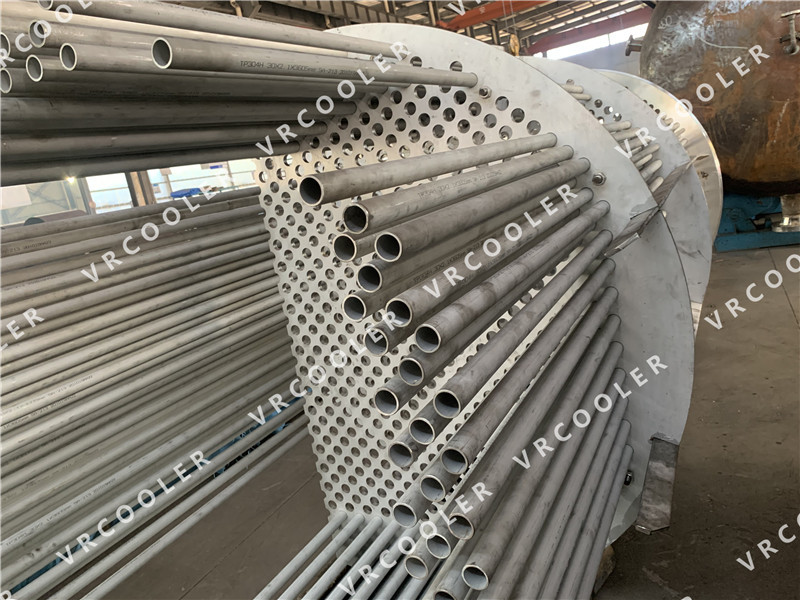
Available design options include fixed tube sheet, U-tube, floating head, removable bundle, stainless steel tubes, alloy steel construction, clad tube sheet, customized nozzle orientation, and design for high-pressure or corrosive process service.
Conclusion
Shell and tube heat exchangers are widely used in hydroprocessing units because they are strong, reliable, maintainable, and flexible in material selection. For hydrotreaters and hydrocrackers, they can handle high pressure, hydrogen-rich process fluids, sour service, fouling risk, thermal stress, and long-term refinery operation.
In these severe refinery applications, heat exchanger design is not only about heat transfer efficiency. It is about safety, reliability, corrosion control, cleanability, and stable operation over many years. This is why shell and tube heat exchangers remain one of the most trusted choices for hydroprocessing service.