
The primary reason comes down to the ocean environment itself: ship motion is the enemy of phase-change refrigeration.
While other evaporator designs might be more thermally efficient on land, a Dry Expansion (DX) system is chosen for ships because its internal physics are largely immune to pitching and rolling.
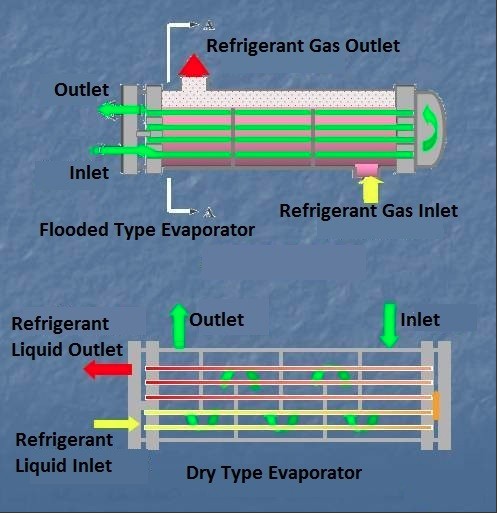
1. Immunity to the "Slosh" (Preventing Liquid Slugging)
A flooded evaporator (the most common high-efficiency alternative) operates by keeping the shell partially filled with a pool of boiling liquid refrigerant.
However, if you put a large pool of liquid on a vessel in rough seas, that liquid sloshes violently. If it splashes over the internal baffles and enters the suction line heading back to the compressor, the result is catastrophic. Compressors are designed to compress gas, not liquid.
Because a DX evaporator precisely meters the refrigerant so it boils completely inside the narrow tubes, there is no large liquid pool to slosh around.
2. Reliable Oil Return
Most marine chillers use halocarbon refrigerants (like R-134a or R-404A), which naturally dissolve and mix with the compressor's lubricating oil. This means oil is constantly leaving the compressor and traveling through the cooling loop. It has to find its way back.
In a DX system: The refrigerant vapor travels through the narrow evaporator tubes at high velocity. This fast-moving gas simply sweeps the entrained oil along the tube walls and carries it right back to the compressor.
In a flooded system: When the high-pressure liquid enters the large, low-velocity pool inside the shell, the oil tends to separate and settle out. Recovering that trapped oil requires complex skimming systems, ejectors, and heaters—all of which are easily disrupted by a rolling ship.
3. Compact Footprint & Lower Charge
Space in a ship's engine room is heavily restricted. Flooded systems require larger shells and massive external "surge drums" (gravity separators) mounted above them to ensure liquid doesn't carry over into the gas line.
DX evaporators eliminate the need for surge drums, making them dramatically more compact.
