
Water–water shell-and-tube coolers are widely used in closed cooling systems because they provide stable heat transfer while keeping the clean circulating water separate from the external cooling water source. In industrial equipment, this separation is important because the closed-loop water is usually treated to reduce corrosion, scaling, and contamination.
In a closed cooling system, water circulates continuously through machines, hydraulic systems, compressors, furnaces, generators, or process equipment. As it absorbs heat, it needs to be cooled before returning to the equipment. A water–water shell-and-tube cooler removes this heat by transferring it to another water circuit, such as cooling tower water, plant water, chilled water, river water, or seawater.
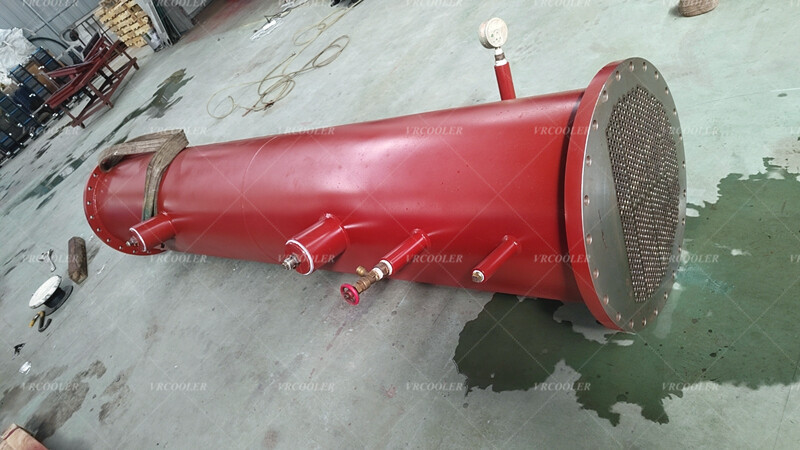
The two water circuits do not mix. One water stream flows through the tubes, while the other flows around the tubes inside the shell. Heat passes through the tube walls from the hotter water to the colder water. This allows the system to remove heat efficiently while protecting the closed-loop water from dirt, minerals, biological growth, and corrosive substances.
This is one of the main reasons shell-and-tube coolers are used in closed cooling systems. They help keep the internal cooling circuit clean and chemically stable. If raw water, seawater, or cooling tower water entered the equipment directly, it could cause scaling, blockage, corrosion, and premature failure. By using a heat exchanger, the external water carries heat away without entering the protected equipment loop.
Another reason is reliability. Shell-and-tube coolers have a strong mechanical structure and can handle continuous operation, high flow rates, pressure changes, and demanding industrial conditions. They can also be designed with different tube materials, shell materials, pressure ratings, and heat transfer areas according to the working environment.
Maintenance is also easier. In many shell-and-tube designs, the tube side can be opened for inspection or cleaning. This is useful when the secondary cooling water contains minerals, suspended solids, algae, sand, or other impurities. The fouling can often be cleaned from the cooler without disturbing the main closed cooling loop.
For medium and large industrial systems, shell-and-tube coolers are especially practical. They are commonly used in power plants, steel mills, chemical plants, marine systems, hydraulic stations, compressors, induction heating equipment, and manufacturing lines. Plate heat exchangers may be more compact in some smaller systems, but shell-and-tube coolers are often preferred when durability, cleanability, and tolerance to dirty water are more important.
In simple terms, a water–water shell-and-tube cooler acts as a reliable barrier and heat transfer device at the same time. It lets clean treated water protect the equipment while another water source removes the heat. This combination of heat transfer, fluid separation, mechanical strength, and easy maintenance makes it a proven choice for closed cooling systems.
