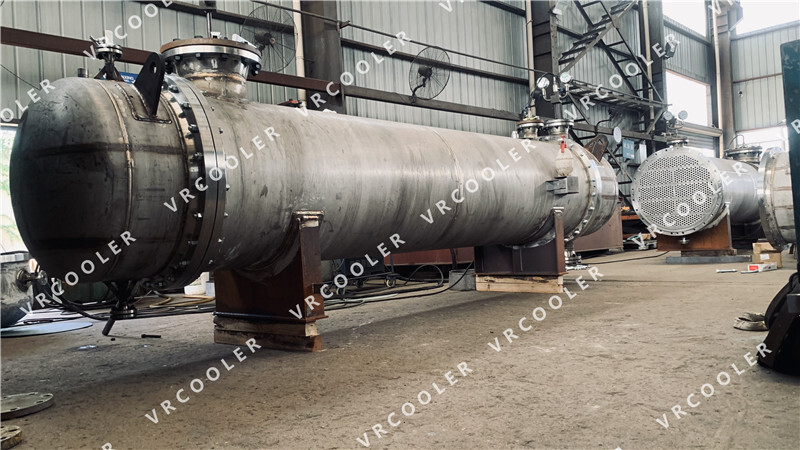
How to calculate the heat transfer area of a shell and tube heat exchanger?
To calculate the heat transfer area of a shell and tube heat exchanger, you can typically use the following general approach:
First, determine the heat load (Q) based on the specific heat transfer requirements of the process. This can be calculated using the equation: Q = m × Cp × ΔT, where m is the mass flow rate of one of the fluids, Cp is the specific heat capacity, and ΔT is the temperature difference between the inlet and outlet of that fluid.
Then, use the overall heat transfer coefficient (U) for the exchanger, which takes into account various factors such as fluid properties, flow conditions, and exchanger geometry.
The heat transfer area (A) can be found using the equation: A = Q / (U × LMTD), where LMTD (logarithmic mean temperature difference) is a measure of the average temperature driving force across the exchanger.
The calculation of LMTD can be a bit more complex and depends on the specific temperature profiles of the fluids. It often involves considering the inlet and outlet temperatures of both fluids and using appropriate equations or graphical methods to determine the LMTD value.
It's important to note that accurate determination of the heat transfer area requires detailed knowledge of the fluid properties, operating conditions, and exchanger characteristics, and may involve iterative calculations or the use of specialized software or design guidelines. Additionally, in practical applications, safety margins and other considerations may also be factored in to ensure proper performance of the exchanger.