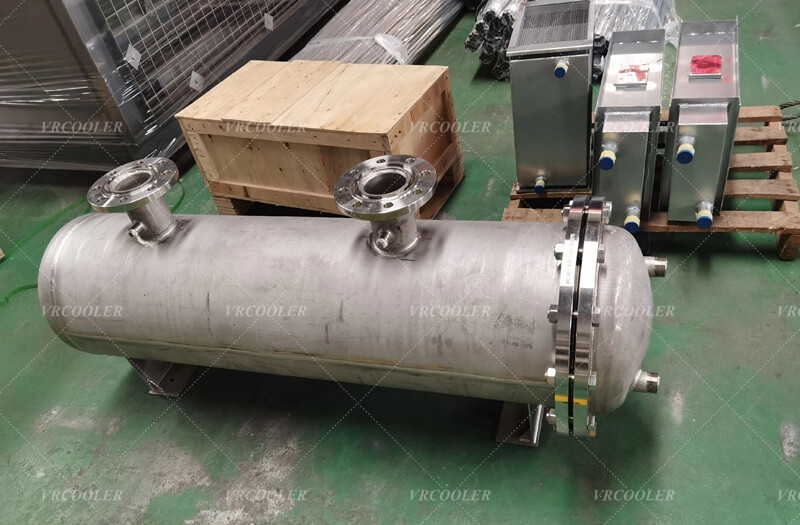
How to improve the heat transfer efficiency of shell and tube heat exchangers?
Here are some ways to improve the heat transfer efficiency of shell and tube heat exchanger:
1. Increase the Heat Transfer Area:
Increase the number or length of heat transfer tubes.
Use shaped tubes such as bellows or finned tubes to increase the contact area with the fluid.
2. Increase Fluid Flow Rate:
Appropriately increase the shell or tube flow rate of the fluid to enhance convection heat transfer. However, note that too large a flow rate may lead to increased pressure drop.
Adopt multi-process design to increase the flow path and disturbance of the fluid.
3. Improve the Fluid Flow Condition:
Install folding plates in the shell course to change the flow direction of the fluid and increase the degree of turbulence.
Optimise the arrangement of the piping, e.g. using a triangular or square arrangement.
4. Improve the Surface Heat Transfer Coefficient:
Treat the surface of the heat exchanger tubes, e.g. increase the roughness or use special coatings.
5. Selection of Suitable Tubing Materials:
Choose materials with good thermal conductivity to make heat exchanger tubes.
6. Control fouling:
Conduct regular cleaning to prevent fouling from accumulating and affecting heat transfer.
Add anti-scaling agent in the fluid.
7. Optimise the import and export structure:
Ensure that the fluid inlet and outlet are well designed to reduce local resistance and flow inhomogeneity.
8. Utilise phase change heat transfer:
The introduction of phase change processes, such as evaporation or condensation, for example, in shell or tube processes, can significantly improve heat transfer efficiency.
For example, in the industrial refrigeration system, by choosing high-efficiency bellows-type heat exchanger tubes and setting reasonable folding plates in the shell and tube process, the heat transfer efficiency of the shell and tube condenser can be effectively improved, thus enhancing the refrigeration effect. In the petrochemical field, regular chemical cleaning of shell-and-tube heat exchangers to remove the dirt on the tube wall can also significantly restore their heat transfer performance.