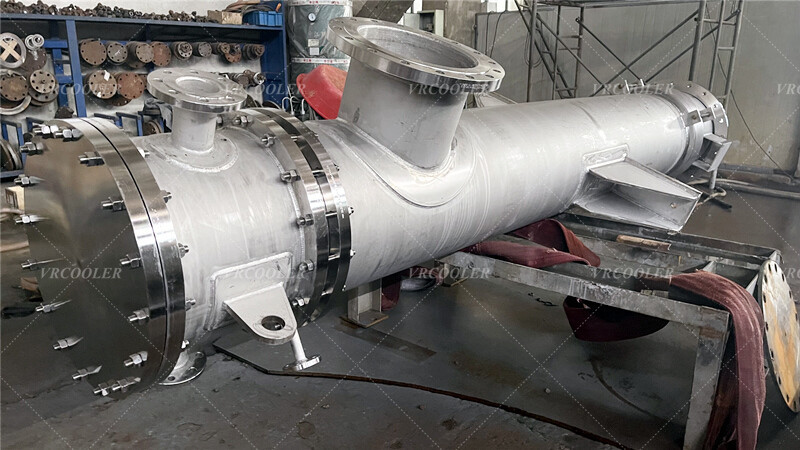
How to Test the Heat Transfer Efficiency of Shell and Tube Evaporators
Shell and tube evaporator heat transfer efficiency can be tested by the following methods:
Test Preparation
Choose suitable test equipment: including flow meter, thermometer, manometer, power meter and so on. These equipments should have enough precision and reliability to ensure the accuracy of test results.
Prepare the medium for testing: according to the actual application of shell-and-tube evaporator, choose suitable refrigerant and refrigerant carrier. For example, in air-conditioning systems, the commonly used refrigerants are R22, R410A, etc., and the carrier refrigerant is water or glycol solution.
Installation of test equipment: Install test equipment such as flow meters, thermometers, manometers, etc. on the inlet and outlet pipes of the shell-and-tube evaporator in order to measure the flow rate, temperature and pressure of the refrigerant and the carrier refrigerant. At the same time, connect the power meter to the drive motor of the evaporator in order to measure the input power of the motor.
Test Steps
Stable operation stage: Start the shell-and-tube evaporator and the associated refrigeration system to run under stable operating conditions for a period of time until the system parameters such as temperature, pressure and flow rate reach a steady state. In this stage, record the parameters such as temperature, pressure, flow rate of the evaporator's import and export and the input power of the motor.
Changing working condition stage: change the working condition of the shell-and-tube evaporator by adjusting the operating parameters of the refrigeration system, such as the flow rate of the refrigerant, the evaporation temperature, the condensation temperature and so on. Under each working condition, the parameters such as inlet and outlet temperature, pressure, flow rate of the evaporator and input power of the motor are recorded.
Data processing stage: Based on the recorded test data, the heat exchange capacity, heat transfer coefficient and heat exchange efficiency of the shell and tube evaporator under different working conditions are calculated. The heat transfer quantity can be calculated by the flow rate of refrigerant and refrigerant-carrying agent, the temperature difference between inlet and outlet as well as the specific heat capacity and other parameters; the heat transfer coefficient can be calculated by the parameters of heat transfer quantity, heat transfer area and temperature difference of heat transfer and other parameters; the heat transfer efficiency can be calculated by the ratio of the heat transfer quantity to the input power.
Precautions
Ensure the accuracy and reliability of the test equipment during the test, and calibrate and maintain the test equipment regularly.
Keep the system running stably during testing to avoid fluctuations and interference. If any abnormality is found in the system, the test should be stopped in time and investigated and dealt with.
When calculating the heat transfer efficiency, factors such as energy loss and heat loss of the system should be taken into account to ensure the accuracy of the calculation results.
The test results should be repeated several times and data analysed to improve the reliability and accuracy of the test results.