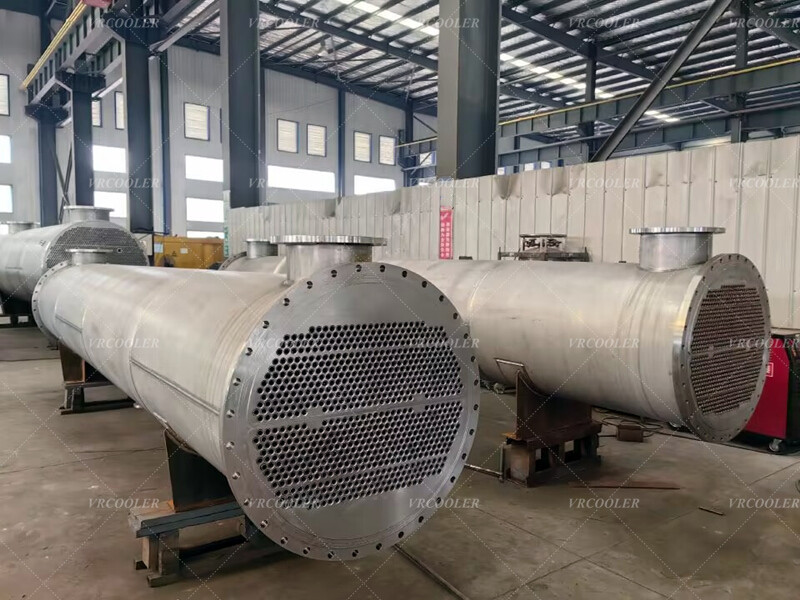
Shell And Tube Condensing Heat Exchangers For The Cooling Side
Shell and tube heat exchangers are widely used for condensing applications on the cooling side due to their effectiveness in transferring heat between two fluids, especially when one of the fluids is in the vapor phase. In such systems, vapor condenses on the shell side while the cooling fluid circulates through the tubes.
Key Features of Shell and Tube Condensing Heat Exchangers:
Shell Side for Condensing:
The vapor, such as steam or refrigerant, enters the shell side. As it cools down through contact with the cooler tube surfaces, it condenses into liquid form.
Tube Side for Cooling:
A coolant (usually water, glycol, or another cooling fluid) flows through the tubes, absorbing the latent heat from the condensing vapor.
Phase Change Considerations:
The design must account for the significant heat transfer that occurs due to the phase change of the vapor as it condenses. This makes the shell and tube design highly efficient for condensing applications.
Material Selection:
Tubes: Copper, stainless steel, or other alloys that resist corrosion and have high thermal conductivity.
Shell: Typically carbon steel or stainless steel, depending on the operating environment and fluid chemistry.
Thermal Design:
The heat exchanger is designed to maintain a proper balance between the heat load (condensation) and the cooling capacity of the fluid inside the tubes.
Baffles in the shell help direct vapor flow, enhancing heat transfer.
Applications:
HVAC Systems: Condensing refrigerants in chillers.
Power Plants: Condensing steam in condensers for turbine operations.
Chemical Processing: Recovery of latent heat from process vapors.
Refrigeration Systems: Condensing refrigerants after compression.