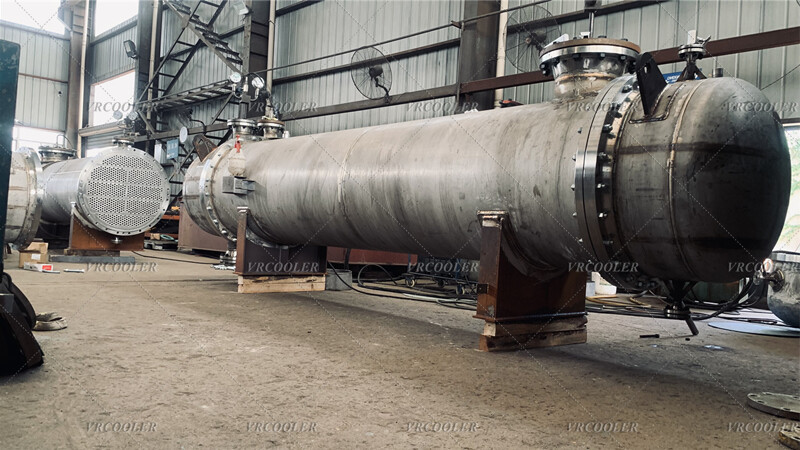
The advantages of shell and tube heat exchangers include:
Robust structure: able to withstand high pressures and temperatures, suitable for harsh working conditions.
For example, in large-scale chemical production, facing high temperature and high pressure process conditions, shell and tube heat exchangers can operate stably.
Higher heat transfer efficiency: Heat transfer effect can be improved through reasonable design, such as increasing the number of tube and shell and tube sections, setting up folding plates, and so on.
Like in the waste heat recovery system of thermal power plant, shell and tube heat exchanger can recover heat effectively.
Wide range of application: it can handle a variety of fluids, including corrosive fluids and fluids containing solid particles.
For example, in the petrochemical industry, it is able to handle media of various complex compositions.
Easy to clean and maintain: the tube and shell processes are relatively independent, making it easy to carry out internal inspection, cleaning and maintenance.
High reliability: has a long service life and stable operation.
Shell and tube heat exchanger also has some disadvantages:
Large size: occupies more space than some compact heat exchangers.
It may be less suitable, for example, in places where space is limited, such as in the power system of a small ship.
High metal material consumption: leads to relatively high costs.
Relatively low heat transfer coefficients: compared to some highly efficient new heat exchangers, the heat transfer coefficients may be less than optimal under the same conditions.
Higher fluid resistance: especially for shell process fluids the flow resistance is higher, which may require an increase in pumping power.
Slower thermal response: The response to changes in operating conditions is not as rapid as some plate heat exchangers.
For example, in a small air conditioning system, if the use of shell and tube heat exchanger, may be due to its large size, high cost and less suitable, at this time the plate heat exchanger may be a better choice. However, in a large industrial refrigeration system, the advantages of a shell and tube heat exchanger are much more prominent and can meet the needs of the system.