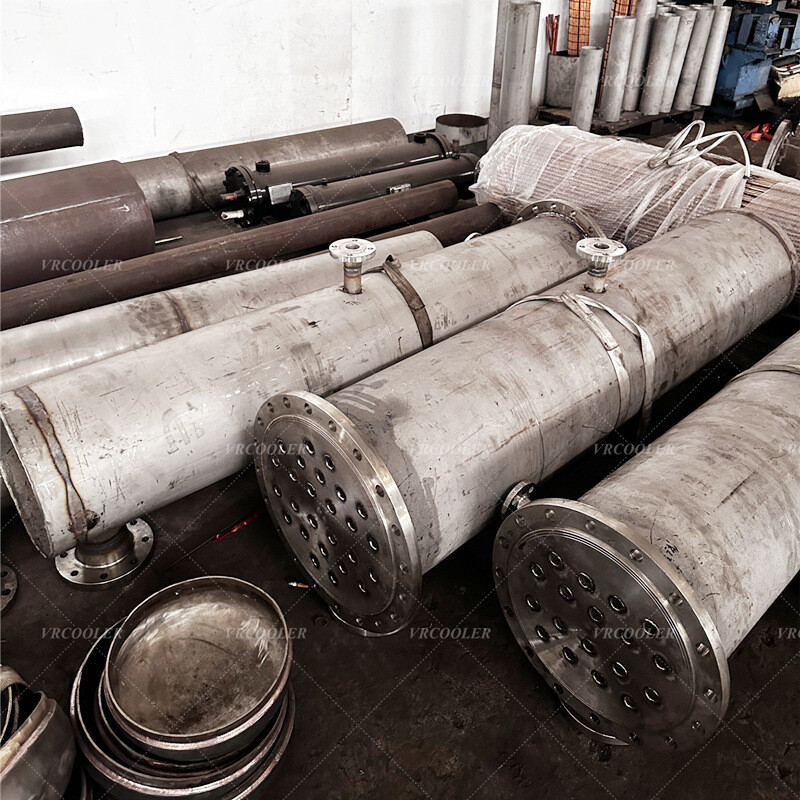
What is The Working Principle of Oil-Cooled Shell & Tube Heat Exchangers?
The working principle of oil-cooled shell and tube heat exchangers is based on the basic principle of heat exchange.
In a shell and tube heat exchanger, the main components are the shell and the tube bundle.
During operation, hot oil enters the interior of the tube bundle from one end of the heat exchanger, while the cooling medium (usually water or air) enters the shell stroke from the other end of the shell.
Due to the temperature difference between the hot oil and the cooling medium, heat is transferred from the hot oil to the cooling medium through the walls of the tube bundle.
Specifically, as the hot oil flows within the tube bundle, its heat is transferred through the tube wall to the cooling medium outside the tube. At the same time, convective heat transfer occurs due to the flow of the fluid, further enhancing the heat transfer.
The cooling medium flows in the shell process, absorbs the heat from the hot oil and increases its temperature, and then flows out from the other end of the heat exchanger.
And the cooled oil, after the temperature is reduced to the required level, flows out from the other end of the tube bundle, thus realising the oil cooling process.
For example, in industrial production, large-scale machinery and equipment operation of high-temperature lubricating oil, through the oil cooling shell and tube heat exchanger for cooling, can be recycled again to ensure that the normal lubrication and operation of the equipment; in the automobile engine, the oil also needs to be cooled through a similar heat exchanger, in order to prevent the high temperature of the oil affects the engine performance and life.