
Large Shell & Tube Heat Exchanger for Palm Oil
In palm oil production, large shell and tube heat exchangers mainly utilize the principles of heat conduction and convection heat transfer. For example, in the cooking process of palm fruit, high temperature steam flows in the shell process and palm fruit pulp flows in the tube process. The heat of the steam is transferred to the palm fruit pulp inside the tube through the tube wall, so that the pulp warms up and realizes the purpose of cooking. In the cooling of fats and oils, usually low-temperature cooling medium flows in the tube process, while high-temperature palm oil flows in the shell process, the heat of palm oil is transferred to the cooling medium, thus realizing the cooling of cooling.
Structural features
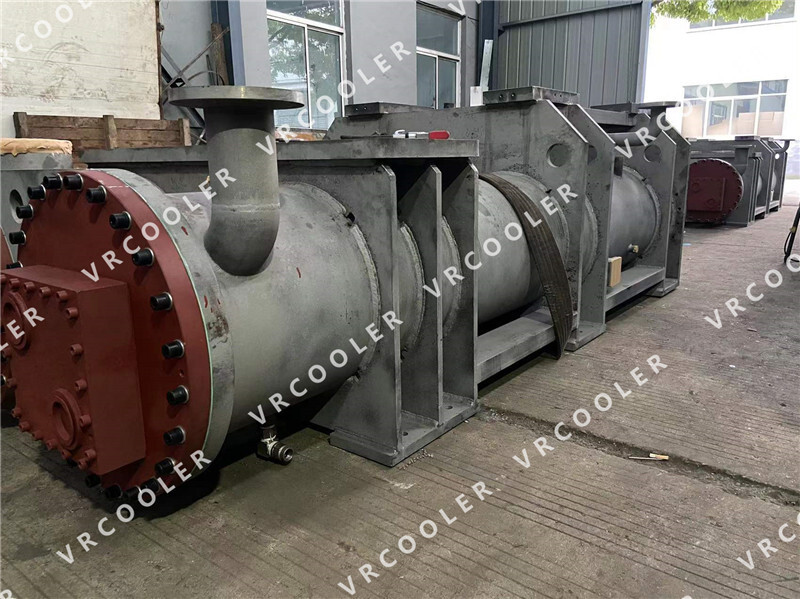
Shell: usually made of carbon steel or stainless steel with large diameter and length to accommodate a large number of heat transfer tubes and fluids. The shell is equipped with import and export receivers for connecting process piping, so that the fluid can enter and exit the heat exchanger.
Heat exchanger tube: is the core component of the heat exchanger, usually stainless steel tube or copper tube, tube bundle arrangement of straight tube type and U-shaped tube type. Straight tube type is easy to clean and repair, U-shaped tube type can adapt to large temperature changes, can effectively prevent thermal stress on the heat exchanger damage.
Tube plate: Located at both ends of the heat exchanger, used to fix the heat exchanger tube, and the shell and tube flow fluid separation. Tube plate and heat exchanger tube connection methods such as expansion, welding, etc., to ensure the sealing and reliability of the connection.
Folding plate: installed in the shell, used to guide the flow direction of the shell process fluid, so that the fluid to a certain flow rate and angle of the heat transfer tube to improve the efficiency of heat transfer. The shape and spacing of the folding plate are designed according to the specific process requirements and fluid characteristics.
Role in palm oil production
Heating process
Raw material pretreatment: Before palm fruits enter the pressing process, they need to be heated and softened. Shell and tube heat exchanger can transfer the heat of steam to the palm fruits, so as to make them reach the appropriate softening temperature, which is conducive to the subsequent pressing operation and improve the oil yield.
Oil refining: in the degumming, deacidification and other refining processes, the oil needs to be heated to a certain temperature. Shell and tube heat exchanger can provide a stable heat source, so that the oil and grease can fully react with various additives, remove impurities and improve the quality of oil and grease.
Cooling process
Cooling after pressing: Palm oil has a high temperature after pressing, and needs to be cooled in time to prevent oxidization and deterioration of the oil. Shell and tube heat exchanger can cool the high temperature palm oil to a suitable temperature for subsequent storage and transportation.
Separation process: In the palm oil separation process, cooling is needed to make the different components of the oil crystallize and separate at different temperatures. Shell and tube heat exchanger can accurately control the cooling temperature and rate to realize palm oil fractionation and get palm oil products with different melting points and applications.
Advantages
Large processing capacity: it can meet the demand of large-scale material processing in palm oil production and adapt to the continuous and large-scale production process.
High heat exchange efficiency: through the reasonable design of tube bundle arrangement, folded plate structure, etc., the two fluids can be efficiently exchanged under a large temperature difference, improving the energy utilization efficiency and reducing the production cost.
Sturdy structure: the structural design of large shell and tube heat exchanger can withstand high pressure and temperature, stable and reliable operation, long-term operation in harsh production environments, reducing the impact of equipment failure on production.
Convenient maintenance: the tube bundle can be disassembled, which is convenient for cleaning, overhauling and replacing the heat exchanger tubes, which reduces the maintenance cost and difficulty, and is conducive to prolonging the service life of the equipment.
Maintenance points
Regular cleaning: During palm oil production, oil and grease and impurities are easy to scale on the surface of heat exchanger tubes, affecting the heat exchange effect. Therefore, it is necessary to use chemical cleaning or mechanical cleaning methods to remove the dirt regularly to ensure the performance of the heat exchanger.
Check the seals: Check the sealing performance of the parts such as the connection between the tube plate and the heat exchanger tube, the sealing surface between the shell and the tube box, and replace the aging or damaged seals in time to prevent fluid leakage.
Monitor corrosion: Due to factors such as corrosive components such as acids that may be contained in palm oil, and humid air in the production environment, the heat exchanger is prone to corrosion. Regularly test the equipment for corrosion and take anti-corrosion measures, such as applying anti-corrosion coatings and adding corrosion inhibitors.
Attention to operating parameters: pay close attention to the heat exchanger temperature, pressure, flow rate and other operating parameters, timely adjustments and deal with abnormalities, to ensure that the equipment operates under the designed conditions, to avoid damage to the equipment due to improper operation.