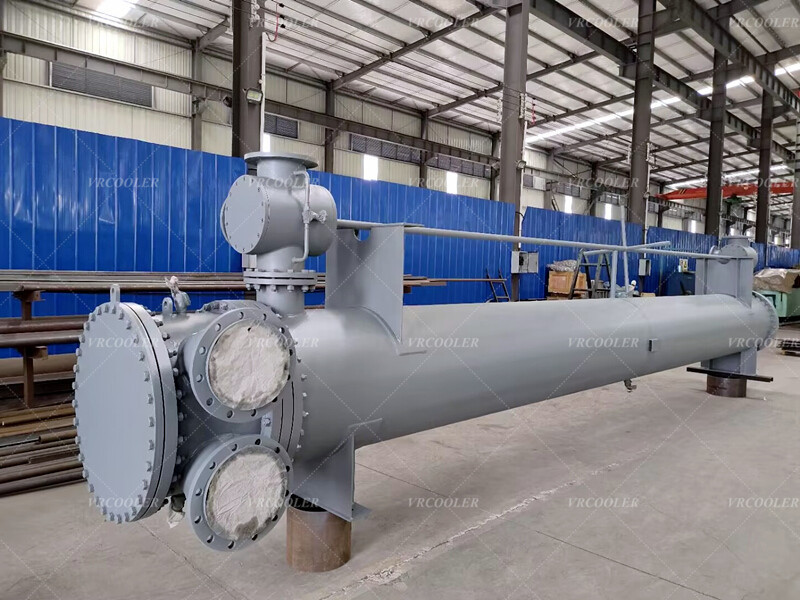
Shell-and-Tube Heat Exchangers in Thermal Power Plants
In thermal power plants, shell-and-tube heat exchangers (also known as shell-and-tube heat exchangers) are one of the core devices for energy conversion and transfer, widely used in critical processes such as steam condensation, water-to-water heat exchange, and waste heat recovery.
1. Turbine Condenser (Most Critical Application)
Function: Condenses turbine exhaust steam (low-pressure steam) into water (condensate) while maintaining the vacuum at the turbine exhaust outlet, thereby improving the thermal efficiency of the unit.
Structure and Media:
Tube side: Circulating cooling water (from the cooling tower, low-pressure, high-flow, prone to scaling).
Reason: Circulating water contains impurities such as sand and microorganisms; routing through the tube side facilitates cleaning (e.g., rubber ball cleaning); High tube side flow velocity (enhancing turbulence) reduces scaling and improves condensation efficiency.
Shell side: Turbine exhaust steam (low-pressure saturated steam, temperature approximately 30–50°C, requiring phase change heat release).
Reason: The shell side has a large space, allowing steam to fully contact the outer surface of the tube bundle, facilitating condensation into water; the shell side pressure is extremely low (near vacuum), eliminating the need to withstand high pressure, resulting in a more economical design.
Typical parameters: The heat exchange area of a single condenser can reach thousands of square meters, with circulating water flow rates of thousands of tons per hour.
2. High- and low-pressure heaters (reheat system)
Function: Utilizes turbine exhaust steam to heat boiler feedwater (condensate → deaerated water → boiler water), reducing boiler heating energy consumption and improving power plant thermal efficiency (core of the reheat cycle).
Classification and medium:
High-pressure heater (HPH):
Tube side: High-pressure feedwater (from the deaerator, pressure 10–30 MPa, clean and free of impurities).
Reason: High feedwater pressure, tube side (small diameter tubes) has stronger pressure-bearing capacity, and flow rate is easier to control to enhance heat transfer efficiency.
Shell side: Turbine high-pressure cylinder extraction steam (pressure 3–10 MPa, temperature 200–400°C, containing a small amount of wet steam).
Reason: Extraction steam requires latent heat release (condensation heat release), and the shell side space facilitates steam condensation and condensate drainage (drainage).
Low-pressure heater (low-pressure heater):
Tube side: Low-pressure condensate water (from the condenser, pressure 0.1-1 MPa, requiring stepwise heating).
Shell side: Steam extraction from the low-pressure cylinder of the turbine (pressure 0.05-0.5 MPa, temperature 100-200°C).
Design features: The shell side is equipped with a drain cooling section to prevent direct mixing of extracted steam condensate with low-temperature condensate, thereby reducing energy loss.
3. Boiler feedwater preheater/economizer (auxiliary heat exchanger)
Function: Utilizes the residual heat from boiler flue gases to preheat boiler feedwater, reduce flue gas temperature, and save fuel.
Medium distribution:
Tube side: Boiler feedwater (clean, high-pressure, must avoid flue gas corrosion) .
Shell side: Boiler flue gas (temperature 200–400°C, containing corrosive gases such as sulfur dioxide, low flow rate).
Design Considerations: The tube side uses corrosion-resistant materials (e.g., ND steel), and the shell side is equipped with baffles to enhance flue gas turbulence and improve heat transfer efficiency.
4. Industrial Water Cooler (Auxiliary System)
Function: Cool auxiliary equipment in thermal power plants (e.g., lubricating oil, generator stator, pump housing, etc.) to ensure normal operation of the equipment.
Medium distribution:
Tube side: Medium to be cooled (e.g., lubricating oil, generator cooling water, low flow rate, clean).
Shell side: Circulating cooling water (high flow rate, low pressure, large temperature fluctuations).
Features: Compact structure, mostly U-tube type (for easy disassembly and cleaning).
5. Waste Heat Recovery Heat Exchanger (Energy-Saving Retrofit)
Function: Recovers waste heat from turbine exhaust steam, flue gas, or process wastewater for heating industrial water or preheating fuel.
Example:
Using flue gas waste heat to heat industrial hot water: Tube side carries industrial water, shell side carries flue gas.
Using condensate waste heat to preheat boiler fuel (e.g., natural gas): Tube side carries fuel, shell side carries high-temperature condensate.
Design Features of Shell-and-Tube Heat Exchangers in Thermal Power Plants
High-pressure/high-temperature resistance: The tube side of equipment such as high-pressure steam generators and boiler feedwater preheaters must withstand pressures exceeding 10 MPa, typically using thick-walled carbon steel pipes or alloy steel pipes.
Scale and corrosion resistance:
The tube side of condensers uses copper alloys (e.g., BFe10-1-1) or titanium tubes (for seawater cooling) to resist seawater corrosion and biofouling.
The tube side of flue gas heat exchangers uses acid-resistant steel to resist sulfur dioxide corrosion in flue gas.
Enhanced Heat Transfer:
The shell side is equipped with baffles (bow-shaped, disc-shaped, or ring-shaped) to enhance turbulence in the medium (especially low-velocity media such as flue gas and steam).
The tube side uses finned tubes or threaded tubes (e.g., economizers) to increase heat transfer area.
Thermal compensation design: In high-temperature conditions (e.g., high-pressure heaters), floating head or U-tube structures are used to prevent stress caused by thermal expansion differences between the tube bundle and the shell.