The Working Principle and Advantages and Disadvantages of Dry Evaporator
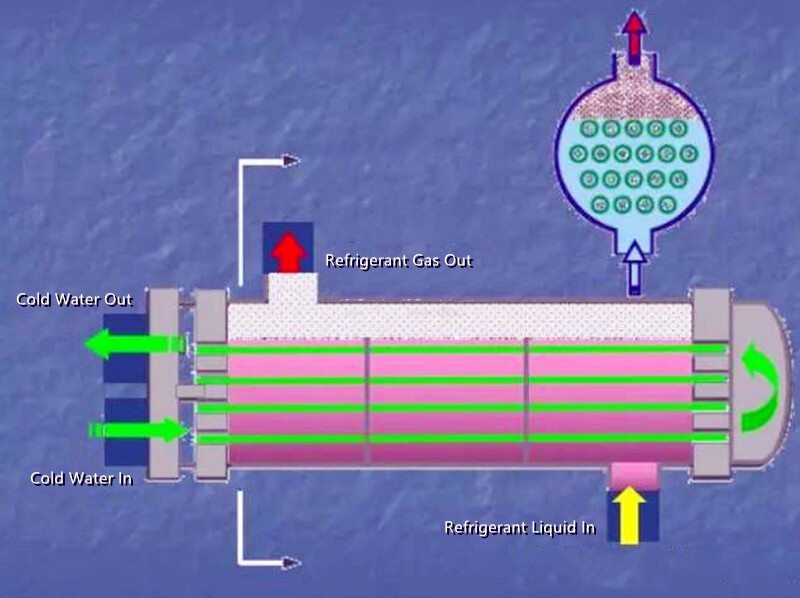
The structure of the dry evaporator is similar to that of the horizontal shell-and-tube evaporator, but the difference is that in the dry evaporator, the refrigerant liquid flows inside the heat exchanger tube while the refrigerant carrier flows outside the heat exchanger tube.
The difference is that in the dry evaporator the refrigerant liquid flows inside the heat exchanger tube, and the refrigerant carrier flows outside the heat exchanger tube.
In this kind of evaporator, the refrigerant charge is less, generally 30%-40% of the volume of the heat exchanger tube, there is no free liquid in the process of evaporation of refrigerant, so it is called dry evaporator.
surface, so it is called dry evaporator.
Dry evaporator is usually used in Freon refrigeration equipment. In order to increase the flow rate of the refrigerant outside the heat exchanger tube, there is a folding plate in the shell of the heat exchanger.
When the refrigerant flows inside the heat exchanger tube, a certain flow rate is ensured to bring the refrigerant oil back to the chiller.
The heat exchanger tube of dry evaporator is generally made of copper tube with diameter ɸ12--- ɸ16, sometimes in order to increase the heat transfer coefficient, the heat exchanger tube is selected with longitudinal fins inside the tube; when using general copper light tube, the heat transfer coefficient of the heat exchanger is 523~580W/(㎡-K); if small diameter copper tube is used with dense row, the Heat transfer coefficient can be increased to 1000 a 1160W/(㎡-K).
Advantages of dry evaporator: refrigerator charge is small, to avoid the phenomenon of heat exchanger tube due to freezing and cracking of the phenomenon of expansion, a more satisfactory solution to the problem of oil return.
Disadvantages of dry evaporator: processing technology is more complex, the heat exchanger tube outside the cleaning is more difficult.