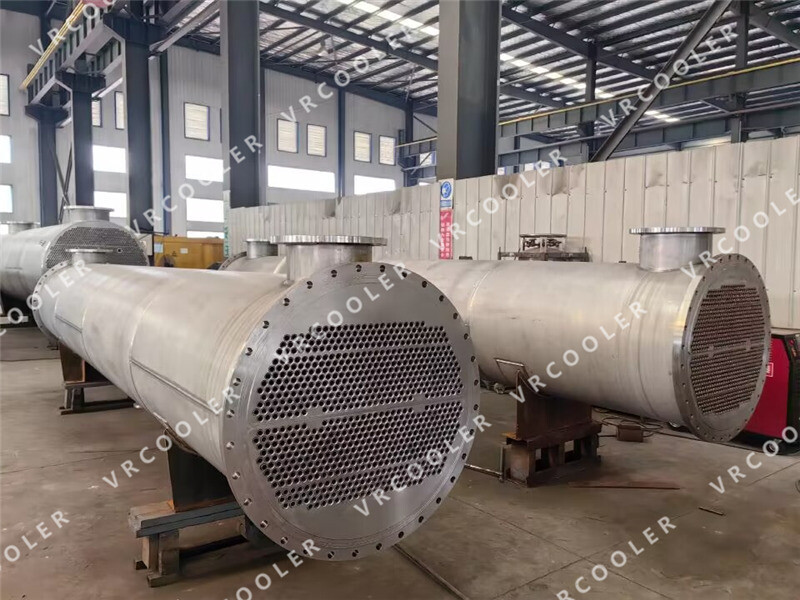
A shell and tube condenser works based on the principle of heat transfer to condense a vapor into a liquid. Here's how it operates:
Fluid Flow:
- The vapor to be condensed enters the shell side of the condenser. On the tube side, a cooling fluid, usually water or a refrigerant, flows.
Heat Transfer Process:
- As the vapor comes into contact with the cooler tube walls, it begins to transfer its heat to the cooling fluid on the other side of the tubes.
- The heat transfer occurs through conduction across the tube wall. The vapor releases its latent heat of condensation, causing it to change from a vapor state to a liquid state.
- The cooling fluid absorbs the heat and exits the condenser at a higher temperature.
Baffles and Flow Enhancement:
- Inside the shell, baffles are often used to direct the flow of the vapor and increase its turbulence. This enhances heat transfer by promoting better contact between the vapor and the tube walls.
- The baffles also help to distribute the vapor evenly across the tube bundle and prevent channeling or bypassing of the vapor.
Condensate Collection:
- As the vapor condenses, the resulting liquid (condensate) collects at the bottom of the shell. It is then drained out through a condensate outlet.
Pressure and Temperature Gradients:
- A pressure gradient is maintained across the condenser, with the vapor entering at a higher pressure and the condensed liquid exiting at a lower pressure.
- Similarly, a temperature gradient exists, with the vapor being at a higher temperature and the cooling fluid entering at a lower temperature and exiting at a higher temperature after absorbing the heat.
Applications:
- Shell and tube condensers are widely used in various industries such as power generation, refrigeration, air conditioning, and chemical processing.
- In power plants, they are used to condense steam from turbines to improve the efficiency of the power generation cycle.
- In refrigeration and air conditioning systems, they condense the refrigerant vapor to release the heat absorbed during the cooling process.