
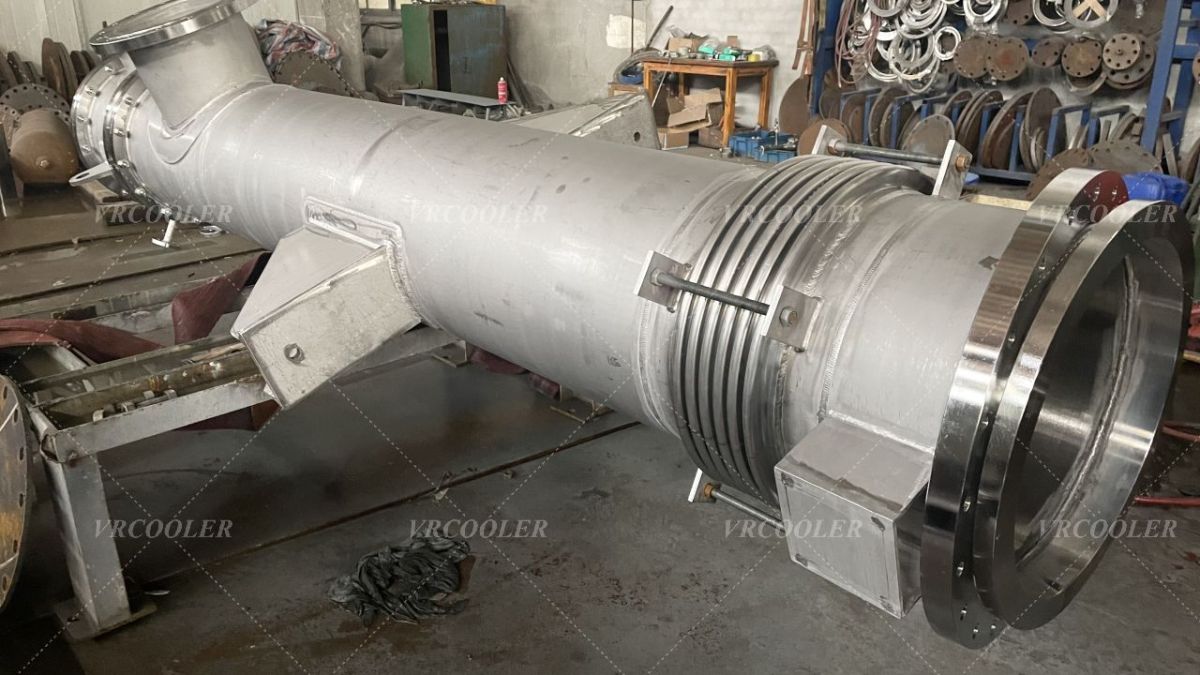
A stainless steel shell-and-tube heat exchanger provides a reliable way to heat condensate water using available low-pressure steam. For the specified application, the exchanger raises 13 m³/h of condensate water from 20°C to 45°C using steam at approximately 5.3 barg and 163°C. The unit will operate intermittently and should be designed for quick startup, stable temperature control and complete drainage after shutdown.
Based on the stated water flow and temperature increase, the required heating capacity is approximately 377 kW. This calculation assumes a water density close to 1,000 kg/m³ and an average specific heat of approximately 4.18 kJ/kg·K. After allowing for heat loss, operating variation and a reasonable thermal design margin, a preliminary exchanger capacity of approximately 400–415 kW would be suitable.
The available steam pressure of 5.3 barg corresponds to an absolute pressure of approximately 6.3 bar. Saturated steam at this pressure has a temperature close to 160–161°C, so the reported steam temperature of 163°C indicates that the steam may be slightly superheated. The small amount of superheat contributes relatively little to the total duty because most of the useful energy comes from steam condensation.
The estimated steam consumption is approximately 650–700 kg/h under full-load conditions. The exact value depends on the actual steam pressure at the heat exchanger inlet, condensate discharge condition, heat loss and whether the steam reaches the exchanger in a dry saturated or slightly superheated state. Wet steam or excessive condensate in the supply line would reduce the available heating performance.
The condensate water should normally flow through the tubes, while steam condenses on the shell side. This arrangement keeps the higher-pressure water inside smaller pressure-retaining components and provides effective heat transfer from condensing steam. It also allows the tubes to be inspected and cleaned more easily by removing the channel cover.
Steam-side condensation offers a high heat-transfer coefficient and an almost constant heating temperature. The large temperature difference between steam at approximately 161°C and water leaving at only 45°C provides a strong thermal driving force. As a result, the required heat-transfer area should be relatively compact compared with a hot-water-to-water exchanger of the same capacity.
The final thermal design must nevertheless avoid excessive oversizing. An exchanger with too much surface area can make outlet-temperature control difficult during intermittent operation. Even a small steam-valve opening may deliver more heat than required, causing the water outlet temperature to overshoot. A properly selected modulating steam control valve should therefore regulate steam flow according to the measured water outlet temperature.
The control valve should be installed in the steam supply line rather than in the condensate outlet. Throttling the condensate line can flood the shell and create unstable heat transfer. The steam space should drain freely through a correctly sized steam trap, with sufficient differential pressure available across the trap under all operating conditions.
The exchanger should be installed with a slight slope toward the condensate outlet. Complete drainage is important because retained condensate can cause water hammer when steam is introduced during the next startup. A separator and drip leg upstream of the exchanger can help ensure that dry steam reaches the shell.
The stated construction uses SS316L for both the shell and tubes. This material provides good corrosion resistance for condensate-water service and offers improved resistance to chlorides compared with SS304. SS316L is also suitable for welded fabrication because its low carbon content reduces the risk of sensitization around welded areas.
The compatibility of SS316L should still be confirmed against a complete water analysis. Although the stated total suspended solids are negligible, other properties such as chloride concentration, pH, dissolved oxygen, conductivity and chemical contamination can influence material performance. Condensate water is often relatively clean, but oxygen ingress or process contamination may create localized corrosion conditions.
The tubesheet, baffles, channel, nozzles and other wetted components should use materials compatible with the SS316L shell and tubes. Mixing stainless steel with unprotected carbon-steel components in the wetted circuit can introduce corrosion risks and contaminate the clean condensate water. Suitable stainless steel fasteners and compatible gasket materials should also be selected.
A removable straight-tube bundle may be considered if regular inspection or cleaning is expected. A fixed-tubesheet design can provide a simpler and more economical construction, but differential thermal expansion between the shell and tubes must be checked. The steam temperature is much higher than the water temperature, especially during startup, so the mechanical design must account for thermal stress.
The working water pressure is specified as at least 3.5 barg. The heat exchanger’s design pressure should be higher than the maximum operating pressure and should include possible pump shutoff pressure, control-valve conditions and system pressure surges. The steam-side design pressure must similarly exceed the maximum possible supply pressure rather than only the normal 5.3 barg operating condition.
Relief protection may be required if tube failure could expose the lower-pressure side to the higher design pressure of the opposite circuit. The final pressure rating, test pressure and applicable pressure-vessel code should be agreed before manufacturing.
Water velocity through the tubes should normally remain high enough to provide good heat transfer without causing excessive pressure drop or erosion. The selected tube diameter, number of tubes and number of passes will determine the velocity. Because the equipment operates intermittently, the tube-side circuit should also avoid stagnant areas where contaminants could accumulate between operating cycles.
The final heat exchanger selection requires confirmation of the allowable pressure drop on both sides, maximum and minimum water flow, required heating time, operating frequency, steam quality, design pressures, nozzle sizes and installation orientation. Based on the current conditions, an SS316L shell-and-tube steam heater rated for approximately 400 kW, with an estimated steam consumption of 650–700 kg/h, provides a suitable preliminary design basis.