
The shell-and-tube heat exchanger is designed for heating process water during concentration service, with the tube-side fluid being water concentrated up to 45% dry matter. The equipment provides a heat transfer area of 200 to 250 m², making it suitable for medium to large thermal duties where stable heat transfer and reliable steam heating are required.
The heat exchanger is constructed from stainless steel, also referred to as INOX, which provides good corrosion resistance, hygienic performance, and long service life in process water applications. Stainless steel construction is especially suitable when the process fluid contains dissolved solids or when cleanliness, durability, and product compatibility are important.
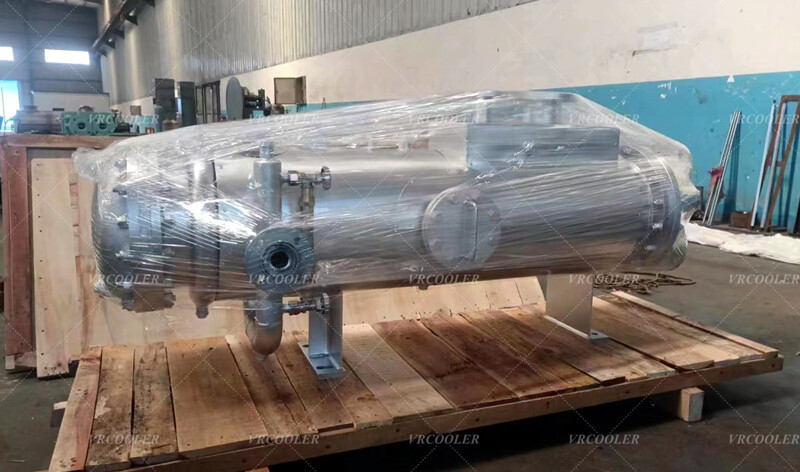
The process water flows inside the tubes. This arrangement is practical because the tube side is easier to control, inspect, and clean when the fluid becomes more concentrated and may have a higher tendency toward fouling or scaling. As the dry matter content increases up to 45%, the viscosity and heat transfer behavior of the process water may change, so tube-side velocity, pressure drop, and cleanability should be carefully considered during final design.
Heating steam flows on the shell side, outside the tubes. Steam is commonly used in this type of heat exchanger because it provides high heat transfer efficiency through condensation. As the steam condenses on the outside surface of the tubes, it releases latent heat to the process water inside the tubes. This allows the process water to be heated efficiently and evenly without direct contact between the steam and the process fluid.
The tube side is designed for a pressure of up to 6.0 bar, while the shell side is designed for a pressure of up to 3.0 bar. This pressure arrangement indicates that the process side must withstand a higher operating pressure than the steam side. Proper mechanical design, tube sheet strength, gasket selection, shell thickness, and pressure safety protection should be confirmed according to the applicable design code and operating conditions.
For this duty, the heat exchanger should also be designed with attention to condensate drainage, steam distribution, thermal expansion, fouling allowance, and maintenance access. Since the tube-side fluid is a concentrating process liquid, features such as removable tube bundles, suitable tube diameter, smooth internal surfaces, and clean-in-place compatibility may be important depending on the actual process requirements.
Overall, this stainless steel shell-and-tube heat exchanger is suitable for steam-heated concentration processes where process water needs to be heated while being concentrated up to 45% dry matter. Its large heat transfer area, stainless steel construction, separate steam and process circuits, and pressure-rated design make it a reliable solution for industrial evaporation, concentration, and thermal processing applications.