
A tubular heat exchanger is a reliable solution for compressed air cooling systems, especially where the compressed air must be cooled by seawater, cooling water, or another industrial cooling medium. In compressor systems, air temperature increases sharply during compression. If this heat is not removed properly, the system may suffer from high discharge temperature, excessive moisture load, reduced downstream equipment life, and unstable operating performance.
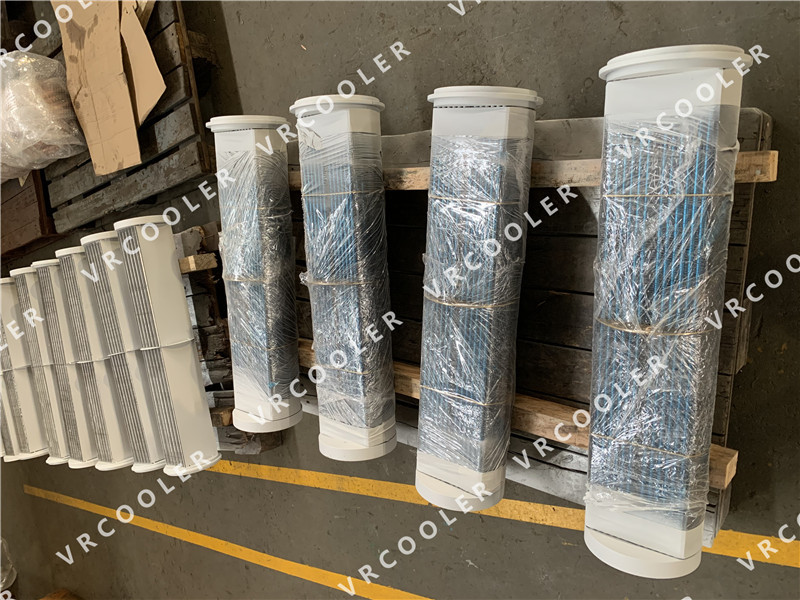
For this compressed air cooling application, the heat exchanger is designed as a shell and tube type cooler. The working fluid on the tube side is compressed air, while seawater is used on the shell side as the cooling medium. The design is suitable for marine, offshore, coastal, industrial, and heavy-duty compressed air systems where corrosion resistance and pressure reliability are important.
The heat exchanger is designed for 1 pass on the shell side and 1 pass on the tube side. Both sides are specified for a maximum working pressure of 110 psig and a design temperature of 300°F. The shell side connections are 1.5 inch NPT, while the tube side compressed air connections are 2.5 inch NPT. This arrangement provides a compact and practical structure for cooling compressed air while keeping the pressure drop within a reasonable range.
Because seawater is involved, material selection is critical. The shell, tubes, tube sheet, and baffles can be manufactured from Titanium Grade 1 or Grade 2. Titanium is highly suitable for seawater cooling service because it offers excellent resistance to chloride corrosion, seawater erosion, and long-term marine exposure. For compressed air cooling in offshore or coastal environments, titanium construction greatly improves service life compared with ordinary carbon steel or standard copper alloy materials.
The heat exchanger core uses 80 titanium tubes, each with a 3/8 inch tube diameter, 23 gauge wall thickness, and 48 inch tube length. The tube bundle pitch is 0.4531 inch, with titanium baffles arranged at approximately 1.5 inch spacing and 20% baffle cut. This type of internal structure helps guide the cooling water flow across the tube bundle and improves heat transfer performance.
During operation, hot compressed air passes through the tubes, while seawater flows across the outside of the tubes inside the shell. Heat is transferred from the compressed air through the titanium tube wall into the seawater. As the compressed air cools, water vapor may begin to condense downstream, so the system should include proper condensate separation and drainage after the cooler. This is especially important in compressed air systems where dry and stable air quality is required.
A tubular compressed air cooler must be designed with attention to pressure drop, fouling, cleaning access, and corrosion resistance. Seawater may contain salt, suspended solids, biological growth, and other impurities, so the heat exchanger should include drain and vent points, removable covers where possible, and enough access for inspection and cleaning. The gasket material should be selected according to seawater temperature, compressed air temperature, pressure rating, and site service conditions.
Compared with air-cooled aftercoolers, a seawater-cooled tubular heat exchanger can provide more compact heat rejection and more stable cooling performance in marine environments. It is especially useful where seawater is already available as a cooling source, such as vessels, offshore platforms, coastal plants, marine compressor stations, and shipboard compressed air systems.
For replacement projects, dimensional matching is also important. The new heat exchanger should be designed according to the original connection sizes, installation length, mounting position, nozzle orientation, pressure rating, and maintenance clearance. For new equipment, the design can be optimized based on compressed air flow rate, inlet and outlet temperature, seawater temperature, fouling factor, allowable pressure drop, and material requirement.
Vrcoolertech can customize tubular heat exchangers for compressed air cooling applications according to actual operating conditions. Available options include titanium, Cu-Ni 90/10, Cu-Ni 70/30, stainless steel, duplex stainless steel, or other corrosion-resistant materials. The design can be adjusted for different air flow rates, cooling water types, pressure ratings, tube sizes, connection standards, and installation layouts.
For this project, the recommended solution is a compact titanium shell and tube heat exchanger with compressed air on the tube side and seawater on the shell side. With titanium tubes, titanium tube sheet, titanium baffles, and a corrosion-resistant shell structure, the cooler can provide dependable heat transfer performance for compressed air cooling in demanding marine and industrial environments.